RICI Pakistan has developed temperature mapping procedures and calibration reports in adherence to ISO/IEC 17025:2017 requirements. Our Calibration Services Technical Manual and Equipment Calibration Services Quality Manual ensure compliance with these international standards. Using the direct comparison method, we provide highly accurate and consistent results across our entire temperature calibration scope. Temperature measurement is critical in nearly every industrial sector in Pakistan.
Calibration of temperature measuring instruments—such as data loggers, thermal imagers, immersion/penetration probes, and thermocouples—is vital. At RICI Pakistan, you can select calibration points based on your quality requirements. We calibrate in the range of -196°C to +1200°C with minimal measurement uncertainties.
Beyond standard temperature instruments, RICI Pakistan also calibrates devices for surface temperature measurements. We offer contact and non-contact calibration for surface probes and sensors. Contact methods include calibration of cross-band probes, mushroom cap sensors, and specialized sensors. Our non-contact surface temperature calibration—ideal for thermal imagers and pyrometers—is performed using black bodies in the range of -18°C to 350°C, accredited to DIN EN ISO/IEC 17025:2018.
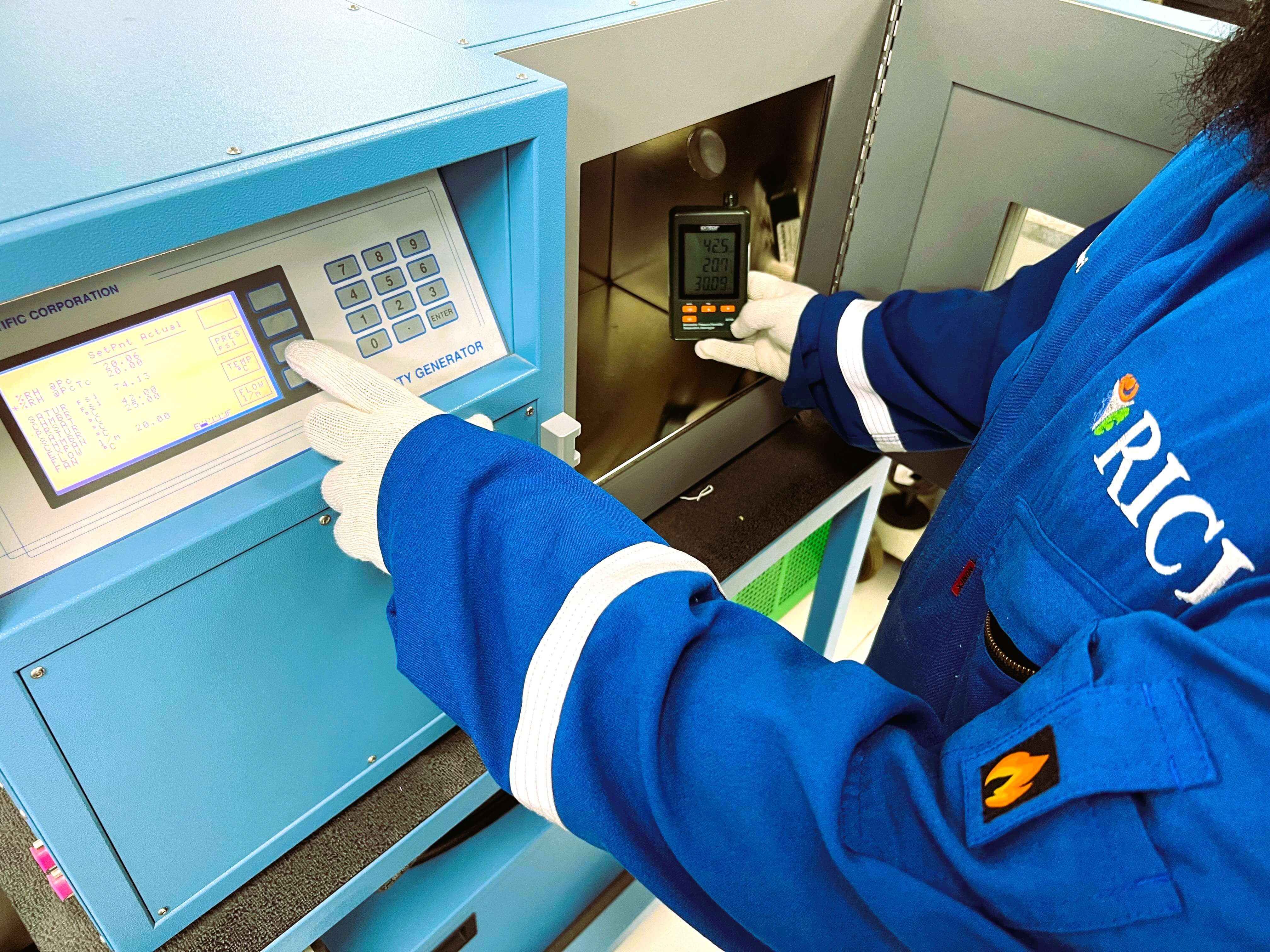
RICI Pakistan’s accredited humidity calibration lab offers high-precision metrological services. With a measuring uncertainty of up to 0.2% RH across 5% to 95% RH (-18°C to +90°C), our calibrations are carried out using state-of-the-art climatic chambers and custom humidity generators developed with PTB collaboration.
Autoclaves
Refrigerators & Freezers
Infrared Thermometers
RTDs
Furnace Calibrations
Temperature Controllers
Dew Point Meters
Incubators
Thermo-hygrometers
Thermal Imagers
Ovens
Data Loggers
Environmental Chambers
Hygrometers
Temperature Transmitters
Thermocouples
Temperature/RH Chart Recorders
Thermometers
Cold & Freezing Rooms
Dry Blocks
<To discover how our services can benefit you, or to receive a free, no commitment quotation, please contact us.
| Test No. | Test Name | ASTM Standard Method | BS Standard Method |
|---|---|---|---|
| 2 | Sampling Freshly Mixed Concrete | ASTM C172 | BS EN 12350-1 |
| 3 | Temperature of Freshly Mixed Hydraulic-Cement Concrete | ASTM C1064 | - |
| 4 | Slump of Hydraulic-Cement Concrete | ASTM C143 | BS EN 12350-2 |
| 5 | Density (Unit Weight), Yield, and Air Content (Gravimetric) of Concrete | ASTM C138 | BS EN 12350-6 |
| 6 | Air Content of Freshly Mixed Concrete by the Pressure Method | ASTM C231 | BS EN 12350-7 |
| 7 | Making and Curing Concrete Test Specimens in the Field | ASTM C31 | BS EN 12390-1/2 |
| 8 | Density of Hardened Concrete | - | BS EN 12390-7 |
| 9 | Water Storage Tanks Used in the Testing of Hydraulic Cements and Concretes | ASTM C511 | - |
| 10 | Capping Cylindrical Concrete Specimens | ASTM C617 | - |
| 11 | Compressive Strength of Cylindrical/ Cubical Concrete Specimens | ASTM C39 | BS EN 12390-3 |
| Serial Number | Test Name | ASTM Standard Method | BS Standard Method |
|---|---|---|---|
| 1 | Sampling Aggregates | ASTM D75 | BS EN 932-1 |
| 2 | Reducing Samples of Aggregate to Testing Size | ASTM C702 | BS EN 932-2 |
| 3 | Aggregate Moisture Content | - | BS 812-109 |
| 4 | Sieve Analysis of Fine and Coarse Aggregates | ASTM C136 | BS EN 933-1 |
| 5 | Material Finer than 75-µm Sieve and 63-µm Sieve in Aggregates by Washing | ASTM C117 | BS EN 933-2 |
| 6 | Clay Lumps and Friable Particles in Aggregates | ASTM C142 | - |
| 7 | Degradation of Coarse Aggregate by Abrasion and Impact in the Los Angeles Machine | ASTM C131 / C535 | - |
| 8 | Soundness of Aggregates by Use of Sodium Sulfate or Magnesium Sulfate | ASTM C88 | BS 812-121 |
| 9 | Density, Relative Density (Specific Gravity), and Absorption of Coarse Aggregate | ASTM C127 | BS EN 1097-6 |
| 10 | Density, Relative Density (Specific Gravity), and Absorption of Fine Aggregate | ASTM C128 | BS EN 1097-7 |
| Serial Number | Test Name | ASTM Standard Method |
|---|---|---|
| 1 | Standard practice for sampling bituminous paving mixtures | ASTM D979 |
| 2 | Standard test method for moisture or volatile distillates in bituminous paving mixtures | ASTM D1461 |
| 3 | Standard test method for theoretical maximum specific gravity and density of bituminous paving mixtures | ASTM D2041 |
| 4 | Standard test method for quantitative extraction of bitumen from bituminous paving mixtures | ASTM D2172 |
| 5 | Standard test method for bulk specific gravity and density of non-absorptive compacted bituminous mixtures | ASTM D2726 |
| 6 | Standard practice for estimating application rate of bituminous distributors | ASTM D2995 |
| 7 | Standard test method for percent air voids in compacted dense and open bituminous paving mixtures | ASTM D3203 |
| 8 | Standard test method for thickness or height of compacted bituminous paving mixtures specimens | ASTM D3549 |
| 9 | Standard practice for sampling compacted bituminous mixtures for laboratory testing | ASTM D5361 |
| 10 | Standard test method for mechanical size analysis of extracted aggregate | ASTM D5444 |
| 11 | Standard practice for preparation of bituminous specimens using Marshall apparatus | ASTM D6926 |
| 12 | Standard test method for Marshall stability and flow of bituminous mixtures | ASTM D6927 |